

Sergio Busquets-Monge , Salvador Alepuz , Joan Nicolàs-Apruzzese , Xavier Jordà , Mariana Raya, Àlber Filbà-Martínez and Gabriel Garcia-Rojas
IEEE Transactions on Power Electronics
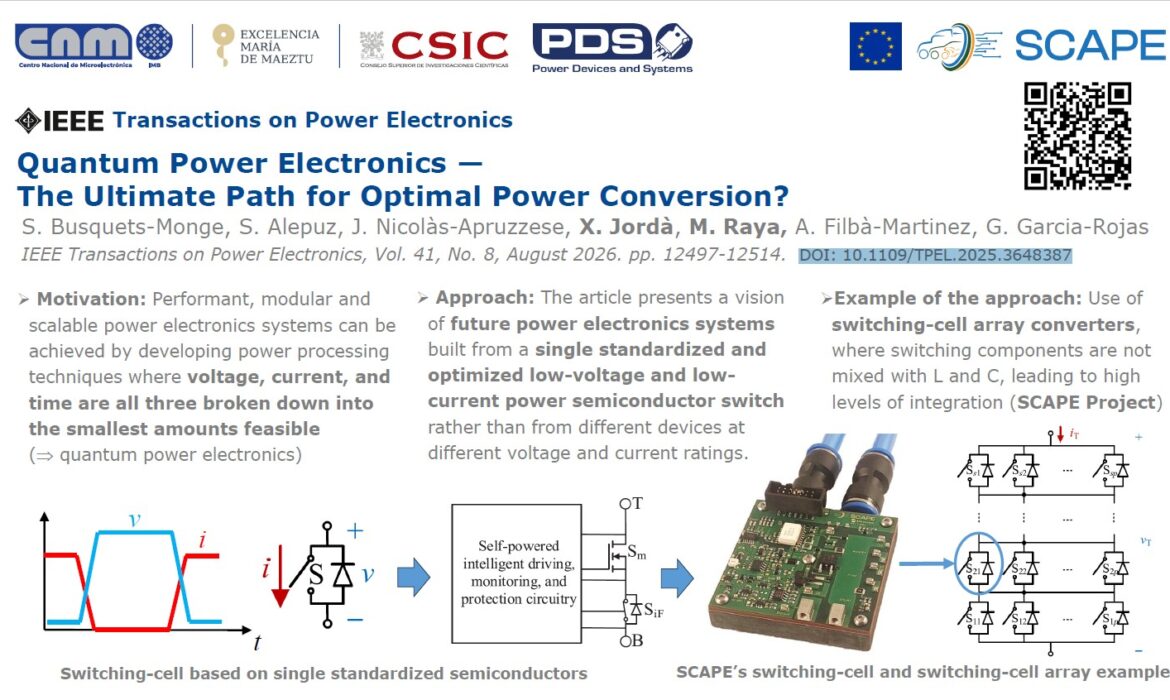
Advances in power electronics play a fundamental role in achieving the technological objectives that society pursues in terms of sustainable use of energy. One promising path to search for notable advances in power electronics is to develop power processing techniques where voltage, current, and time are all three broken down into the smallest amounts feasible, in what could be referred to as quantum power electronics. Since the product of voltage, current, and time defines electrical energy, breaking them down into the smallest quantities feasible (viable and suitable in the context of the state-of-the-art of power electronics devices and systems) enables processing power through processing small energy quanta. A discussion is provided to justify that this, in principle, could bring substantial benefits in terms of standardization, modularity, scalability, flexibility, versatility, efficiency, power density, reliability, cost, and other performance features at system level. That is, this article shares a vision of future power electronics systems as built from a single standardized and optimized low-voltage and low-current power semiconductor switch rather than from a number of different switches at different voltage and current ratings. One of the possible paths to implement these power processing techniques is through the use of switching cell arrays,
where switching components are not mixed with energy storing components, potentially leading to high levels of integration.
Link DOI: 10.1109/TPEL.2025.3648387