

Aniol Vellvehí, Pierre Gallarday, Edgars Butanovs, Vincent Sallet, José Rebollo, Josep Montserrat, Edvards Strods, Martins Zubkins, Lauris Dimitrocenko, Corine Sartel, Ekaterine Chikoidze, Xavier Perpiña, Miquel Vellvehi, Amador Pérez-Tomás
Journal of Alloys and Compounds
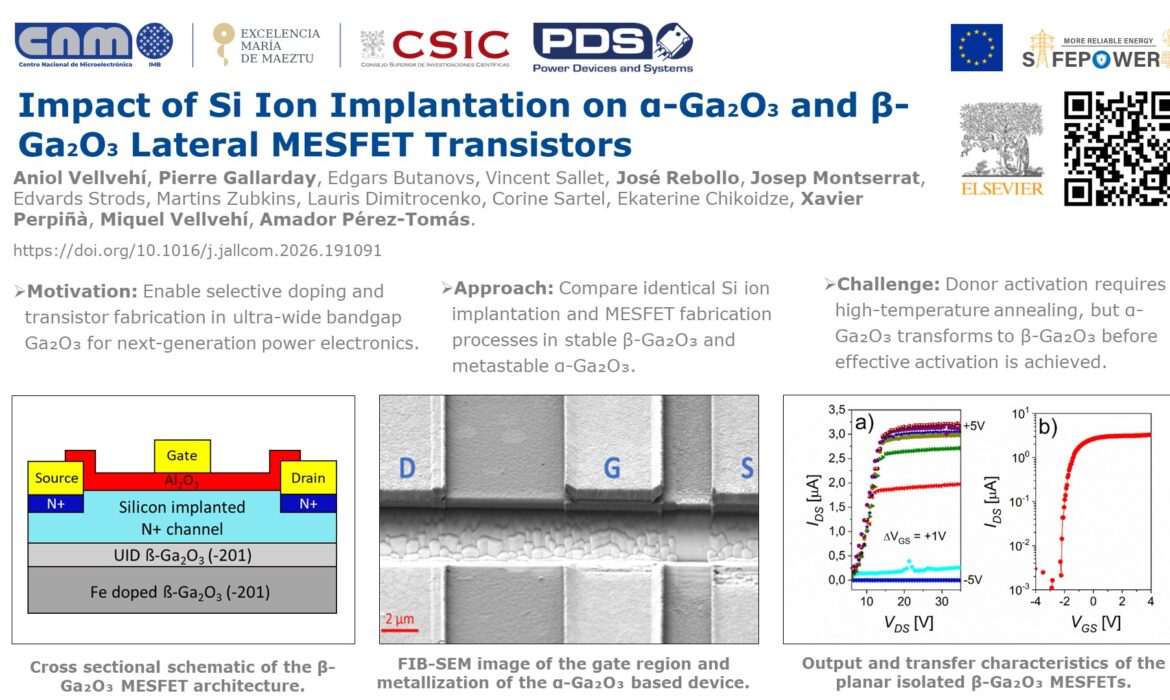
In this work, the feasibility of Si ion-implantation channel engineering in metastable α-Ga2O3 is directly compared with the well-established implantation process used in β-Ga2O3 lateral MESFETs. Identical multi-energy Si implantation schemes (10–200 keV) and thermal annealing conditions were applied to both polymorphs in order to evaluate the compatibility of implantation-based doping with the thermal stability window of α-Ga2O3. For β-Ga2O3, Si implantation followed by high-temperature annealing (900–1100 °C) successfully enabled conductive channel and ohmic contact formation, leading to functional lateral MESFET operation with proper current modulation and saturation behaviour. In contrast, α-Ga2O3 layers grown on m-plane sapphire exhibited a strong limitation associated with their metastable nature. An ALD-deposited Al2O3 capping layer delayed the α→β phase transition up to approximately 700 °C, as confirmed by X-ray diffraction analysis. However, electrical measurements revealed no measurable channel conduction after annealing within this temperature range, suggesting that efficient electrical activation of the implanted Si donors was not achieved within the α‑Ga₂O₃ thermal stability window. At higher annealing temperatures, where dopant activation would normally be expected, the α-phase underwent complete reconstructive transformation into β-Ga2O3, accompanied by severe structural degradation and suppressed electrical transport. These results demonstrate that the thermal budget required for conventional implantation-based donor activation exceeds the metastability window of α-Ga2O3, even when thermal stabilization layers are employed. The study therefore identifies a fundamental technological limitation for ion-implantation-defined α-Ga2O3 power devices and highlights the need for alternative low-thermal-budget doping and device fabrication strategies..
Link DOI: 10.1016/j.jallcom.2026.191091
Honestly, the focus on just ‘options’ misses the cognitive aspect. It’s more about the pattern of engagement. Need to look deeper at the reward cycle. Check this out: bd111 ভিআইপি.