

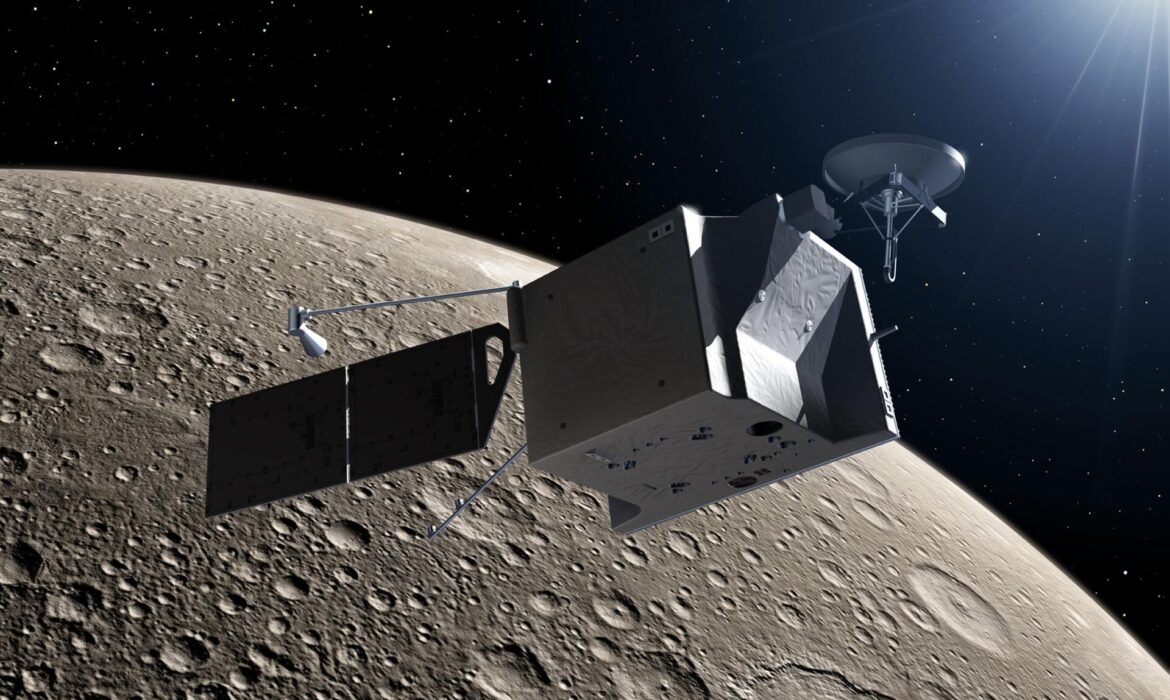
BepiColombo spacecraft approaching Mercury.
After eight years of travelling through the Solar System and covering approximately 10 billion kilometres, the BepiColombo spacecraft successfully entered orbit around Mercury on November 21, 2026.
BepiColombo, a joint mission of the European Space Agency (ESA) and the Japan Aerospace Exploration Agency (JAXA), was launched in October 2018 with the aim of investigating Mercury’s surface, internal structure, magnetic field and surrounding space environment.
ESA has confirmed that the spacecraft is now safely orbiting Mercury. Over the coming weeks, a series of orbital manoeuvres will prepare the spacecraft for the separation of its two scientific orbiters: ESA’s Mercury Planetary Orbiter (MPO) and JAXA’s Mercury Magnetospheric Orbiter (Mio).
The Power Devices and Systems (PDS) Group of the Institute of Microelectronics of Barcelona (IMB-CNM, CSIC) contributed to this mission through the development and fabrication of 720 silicon carbide (SiC) Schottky diodes, integrated into the spacecraft’s solar panels to protect their photovoltaic cells.
These devices, fabricated in the Micro and Nanofabrication Clean Room of the IMB-CNM, were specifically designed to withstand extreme temperatures ranging from −150 °C to +300 °C, taking advantage of the properties of silicon carbide as a wide-bandgap semiconductor.
The separation of the two scientific orbiters is scheduled for December 2026. Further orbital adjustment manoeuvres will bring the spacecraft into their respective scientific orbits, with scientific operations expected to begin in April 2027.
The mission will provide new insights into Mercury’s composition, geological evolution and magnetic environment, contributing to a better understanding of the formation and evolution of the inner Solar System.
More information:
ESA: BepiColombo safely in Mercury orbit despite unexpected challenge